
How to Reduce Mistakes in Lab

Lessons From the Bench: Minimizing Errors Before They Happen
1️⃣ Fully understand the protocol (before you put on your gloves)

Read the entire protocol from start to finish, not step-by-step in real time.
Make sure to note:
Time-sensitive steps such as incubating, centrifuging, warming up, etc.
Overlapping steps to reduce time such as warming up media while incubating cells.
Points where mistakes are irreversible to be extra cautious.
If possible, simulate the workflow mentally or annotate the protocol.
Most mistakes happen not from lack of knowledge, but from misjudging timing or sequence.
Familiarity reduces hesitation and panic during critical steps.
2️⃣ Pre-calculate and label everything in advance
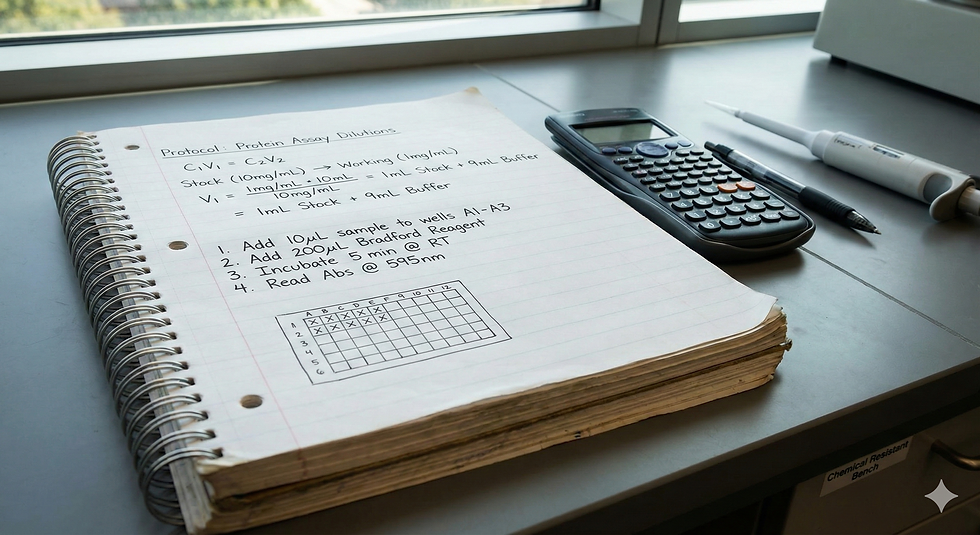
Pre-calculate:
Volumes
Dilution factors
Cell numbers
Write down:
Media names
Additives (serum %, antibiotics, etc.)
Final concentrations
Prepare a written checklist before starting or write calculations on a post-it and stick it on the clean bench.
Tips
Never calculate while pipetting, as it may cause confusion.
Write calculations on paper or a tablet—not in your head.
3️⃣ Limit the number of samples per run

Handle only the maximum number of samples you can process confidently.
Avoid overloading yourself just to save time - this may delay your process.
Too many samples increase:
Tube mix-ups
Skipped steps
Inconsistent timing
Fewer samples = higher consistency and traceability
4️⃣ Clean and organize your workspace before starting

Arrange tools in the order of use.
Remove unnecessary items from the bench.
Prepare waste containers, ice, and timers before starting.
Always keep your bench clean to prevent any contamination.
5️⃣ Label everything clearly

Tubes with names and dates
Plates with cell type or passage number or treatment
Tips
Label before filling the tube, not after.
Include date, sample name, condition, initials, etc. in abbreviation.
6️⃣ Review and record immediately after the experiment

Record:
Procedure besides the protocol
Unexpected outcomes
Timing differences
Small notes today prevent repeated mistakes tomorrow


Comments