
AI Expanding to Cell Analysis

From subjective observation to quantitative, scalable, and reproducible biology
We live in a world where AI has quietly become part of everyday decision-making.
Beyond convenience, AI now plays a critical role in processing complexity—especially in fields where data exceeds human perception. As AI expands into scientific research, long-standing limitations in data interpretation are changing.
Current limitation of cell biology
Cells may look similar, but they are completely different, even within the same cell line, in terms of morphology, cell cycle state, etc. With the human naked eye, analyzing results may vary from person to person. Thus, having a standard in analyzing becomes very critical to prevent variation.
How AI is applied to cell analysis
2-1. Advancements in Cell Structure Analysis
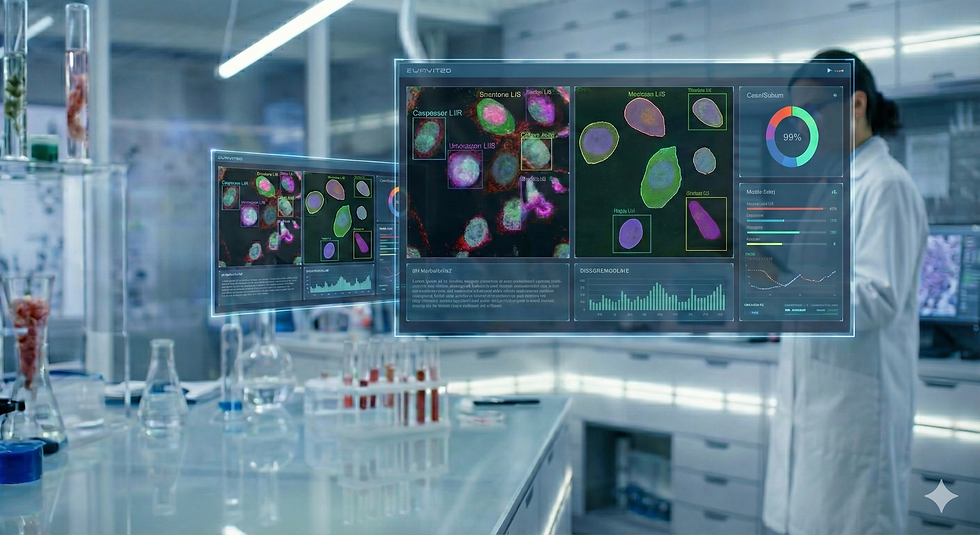
AI is revolutionizing how we extract data from cellular imagery. Recent deep learning models can now accurately segment nuclei in aggregated or overlapping cell populations where traditional methods often fail. Using semi-supervised learning, these models achieved impressive accuracy (75–78% of Dice Similarity Coefficient), proving that AI can automate complex visual tasks. This shift not only cuts down on manual labor and costs but also enhances the accuracy required for personal clinical treatments.
2-2. AI-Driven Drug Discovery: The Lab-in-the-Loop Era
The integration of deep learning and transcriptomics is transforming drug discovery from a "trial-and-error" process into a predictive science. By using a lab-in-the-loop framework, researchers at the Broad Institute and MIT are combining machine learning with real-world phenotypic screening to create an iterative feedback loop.
Speed: AI screens molecules much faster than human researchers ever could.
Complexity: The model identifies compounds that influence disease phenotypes through multi-pathway mechanisms that are often too complex for traditional analysis.
Precision: This framework uncovers new druggable targets by decoding the intricate language of gene expression.
AI is rapidly transforming cell analysis and drug discovery. By automating image analysis and interpreting complex biological data, AI reduces the limits of manual research and accelerates drug discovery. These advances help scientists better understand disease mechanisms and move toward more efficient and personalized medicine.
References:


Comments